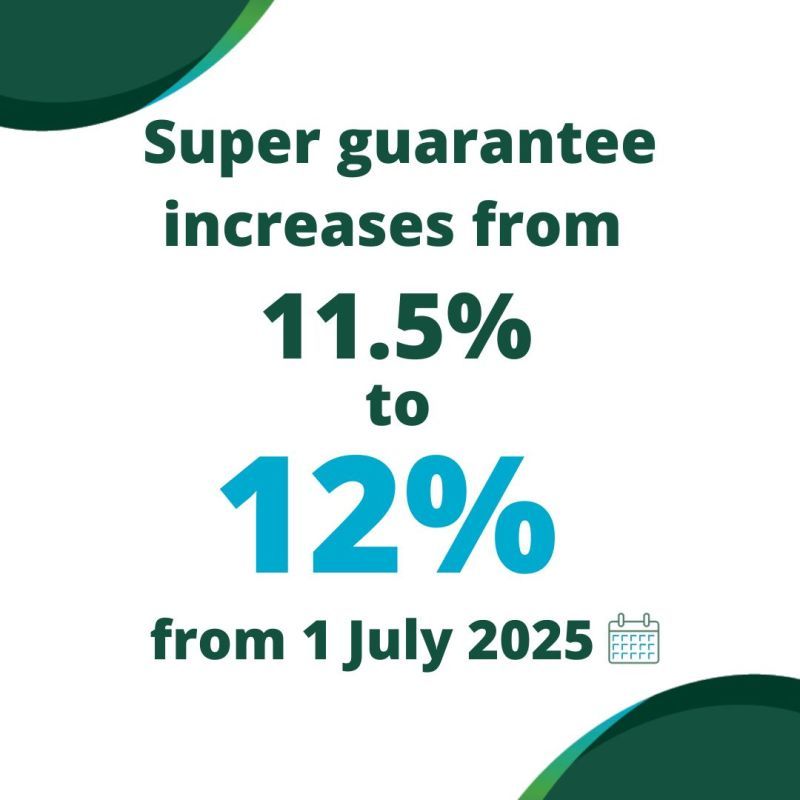
12% Superannuation Guarantee - 1 July 2025

Caroline Gillies • June 22, 2025

From 1 July 2025, the Superannuation Guarantee (SG) rate in Australia will increase to 12%.


This means employers will be legally required to contribute at least 12% of an eligible employee's ordinary time earnings to their superannuation fund.


This increase is the final step in a legislated rise from 9.5% in 2021 to 12% by 2025, aimed at boosting retirement savings for Australian workers.


If you use Xero for payroll, the SG rate should automatically update in the system. However, we recommend you double-check your payroll settings to ensure everything is correct. If you’re unsure or need assistance, please contact your bookkeeper or get in touch with us at:

Clear Vision Accountancy Group

(07) 4688 2500


We’re here to help you stay compliant and avoid any costly errors.

By Caroline Gillies March 1, 2026
From 1 July 2026, the Federal Government will introduce one of the most significant changes to superannuation administration in recent years: “Payday Super.” These reforms fundamentally shift how and when employers meet their Superannuation Guarantee (SG) obligations. What’s Changing? Under the new rules, SG contributions must be paid at the same time as salary and wages and received by the employee’s super fund within seven business days of payday. This replaces the current quarterly payment system. The changes apply to all eligible employees, including those captured under the expanded definition of “employee,” and extend to salary sacrifice amounts and other qualifying earnings (QE). Employers will calculate SG at the legislated 12% rate on QE, which includes ordinary time earnings and relevant additional payments. Contributions remain subject to the Maximum Contribution Base, limiting employer liability to approximately $30,000 per employee per financial year. Employers will also be required to report QE and SG liabilities through Single Touch Payroll (STP), enabling the ATO to monitor compliance more closely and identify underpayments earlier. Operational Impact for Employers The shift to payday reporting and payment means payroll systems must be updated to calculate, process, and remit super contributions each pay cycle. Businesses will need to ensure their software can manage QE calculations and facilitate timely electronic payments to super funds. Cash flow management will also require attention, particularly for small businesses accustomed to quarterly payments. Super will become a real-time obligation rather than a periodic liability. Importantly, failure to meet the new deadlines will trigger the revised Superannuation Guarantee Charge (SGC), including penalties and interest. While late contributions and SGC amounts remain tax deductible, interest and penalties do not. Employers currently using the Small Business Superannuation Clearing House must transition to alternative payment solutions before its closure on 30 June 2026. Preparing Now Although implementation begins in 2026, early preparation is essential. Reviewing payroll systems, assessing cash flow impact, and updating internal processes will help ensure a smooth transition and minimise compliance risk. Payday Super represents a move toward greater transparency and timeliness, but it also demands proactive planning from employers. If you would like assistance preparing your business for Payday Super, our team at Clear Vision Accountancy Group is here to help. Please contact us on 4688 2500 to discuss how we can support your transition and ensure you remain compliant. We drew inspiration for this article from the ATO
By Caroline Gillies December 11, 2025
The ATO is cracking down on people who claim too many tax deductions for properties that they use both personally and as rentals — especially holiday homes. A new draft ruling says that if you use a property for both personal use and renting it out, you must split (apportion) the expenses in a fair and reasonable way. You can only claim deductions for the portion of time or space used to earn rental income. If the ATO thinks your property is really a holiday home — for example, you block out peak times for your own use and only rent it occasionally — they can classify it as a “leisure facility.” If that happens, you cannot claim big expenses like mortgage interest, council rates, land tax or maintenance. You’ll only be allowed to claim small costs like cleaning, advertising and platform/agent fees. The ATO says many owners of holiday homes have been claiming too much by showing “rental losses” every year. They are now looking more closely at cases where the owner keeps the property unavailable for rent during busy periods.  How do I stay off the ATO naughty list? If you mix personal use with rental use, be careful. Only claim the rental part of your expenses, or the ATO may deny most of your deductions.
By Caroline Gillies October 17, 2025
From 1 October 2025, the Australian Taxation Office (ATO) officially closed the Small Business Superannuation Clearing House (SBSCH) to new users. Thanks to the efficiencies of Xero, this change does not impact Xero clients, as Xero includes its own built-in auto-super functionality. This means employers can make superannuation payments directly through Xero—without needing to access the ATO’s separate clearing house service. Key Dates and Details No new users: From 1 October 2025, the SBSCH stopped accepting new registrations. Full closure: The SBSCH will be fully decommissioned on 1 July 2026. Existing users: Businesses currently using the SBSCH can continue until 30 June 2026 but are encouraged to transition to an alternative solution before this date. At Clear Vision Accountancy Group, we highly recommend Xero as an efficient, streamlined, and ATO-compliant payroll and superannuation solution. If you’d like to discuss transitioning your business to Xero, call our team today on (07) 4688 2500 — we’re happy to help.